

Legally reviewed by: Jessica Anvar Stotz, JD, MBA
General Motors (GM) is under scrutiny for continued issues with the “Shift to Park” defect that prevents drivers from shutting off and locking their vehicles. This issue affects owners and lessees of many GMC and Chevrolet model vehicles.
Many of the complaints regarding the shift-to-park issues involve drivers who are forced to constantly wiggle and move the electronic shifter to get it to recognize that the shifter has been placed in the ‘Park’ position. This has resulted in drivers getting trapped in their vehicles because the vehicles fail to shift to the ‘Park’ position preventing people from being able to exit their vehicles.
Drivers report that their vehicles routinely fail to recognize that they have been placed into park and display a message urging them to “Shift to Park.” When this happens, drivers can be left stranded in their vehicles as they are unable to shut them off. Affected vehicles may also roll away if they are not properly in Park.
This issue often results in needing a full transmission replacement, which is costly and timely.
GMC Shift to Park Recall Overview
Various Chevy and GMC “Shift to Park” suits have been filed wherein the plaintiffs allege that certain GM and Chevrolet vehicles cannot be turned off even after shifting into PARK. This prevents drivers from shutting off and locking their vehicles.
Many GM consumers claim that the batteries in their vehicles constantly drain as a result of the Shift to Park issue, regularly leaving them stranded. Drivers who do manage to put their vehicles in PARK often must resort to toggling the shifter repeatedly into other gear positions and back to PARK so that the vehicle recognizes that it is in PARK.
One 2017 GMC Acadia driver noted in their formal complaint to the National Highway Traffic Safety Administration (NHTSA): “I pulled into my garage on 7 June 2019, and placed my vehicle into park, applied the parking brake and then turned off the vehicle and an Action Require message came up with Shift to Park. I started my vehicle and disengaged the park brake backed up and then came forward again and turned the vehicle off and the same message appeared. I played with the shifter and after about 5 minutes, the alert went off.”
Allegedly, GM has known about this defect for several years now. The automaker issued a technical service bulletin (TSB PIT5616A) to GM dealers in June 2018. The TSB discusses a Shift to Park message that appears even when affected vehicles are in PARK. GM told dealers that affected vehicles may not shut off while in PARK and can fail to start due to an “unknown” cause. The TSB offers directions to help fix the issue, however, the very end of the bulletin says that it will be updated once “the final root is understood.”
How to Fix the GM Shift to Park Problem
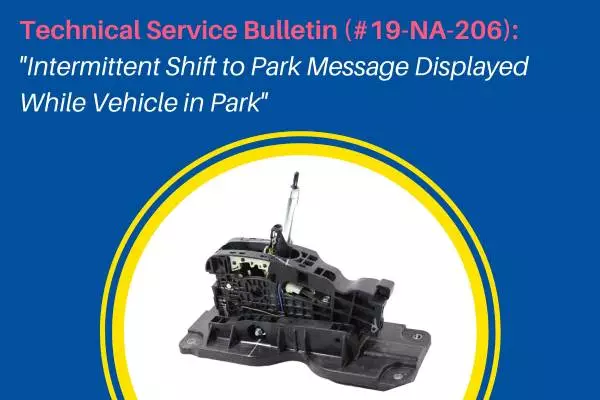
GM has issued a fix for the intermittent “Shift to Park” message issue affecting several models, including the Chevrolet Blazer, Malibu, Traverse, Volt, and GMC Acadia.
This problem occurs when the vehicle is shifted into Park and the ignition is turned off, sometimes causing a diagnostic trouble code (DTC B000A). The issue is due to the park switch in the transmission control assembly not properly signaling to the body control module (BCM) that the vehicle is in Park.
The corrective procedure involves removing and replacing the transmission control, installing a new shifter harness, and adding an in-line shifter wire harness jumper.
Technicians need to disassemble the shift control to access and replace the park switch and other related components, ensuring all connections are properly secured and functioning. After reassembly, a verification step is required to confirm that the “Shift to Park” message no longer appears.
Cost of Fixing GM Shift to Park Problem
This fix is covered under the vehicle’s Bumper-to-Bumper warranty or the Voltec Warranty for specific models. The repair process varies slightly in duration depending on the model, ranging from 0.7 to 1.4 hours.
Parts required include the harness assembly for the transmission control wiring and, if necessary, a new cover for the transmission control. As this issue is part of a legally mandated recall, GM dealerships are required by law to perform the necessary repairs at no cost to the vehicle owner.
Is Shift to Park Covered under Warranty?
Shift to Park issues should be covered under warranty if they first appeared during the warranty period, however, several Acadia drivers say that GM is not honoring their New Vehicle Limited Warranty. These warranties supposedly cover “repairs to correct any vehicle defect, not slight noise, vibrations, or other normal characteristics of the vehicle due to materials or workmanship occurring during the warranty period. Needed repairs will be performed using new, remanufactured, or refurbished parts.”
One 2017 Acadia driver noted in her formal complaint to NHTSA that she was forced to pay out-of-pocket for repairs because her SUV had 36,189 miles, 189 miles over the warranty period: “I was told that they could do a diagnostic test that will cost me $135 to see if they could find out what the problem is and that it wasn’t going to be covered by the warranty because I was over 36,000 miles. I have an appointment to take it in the morning and the dealer is over 50 miles away, so I’ll be even more over the warranty miles.”
Although these issues should be covered under GM’s warranty, GM drivers are often left paying for repairs out-of-pocket- for a problem that the automaker has no idea how to fix.
What Makes and Models Does Shift to Park Affect?
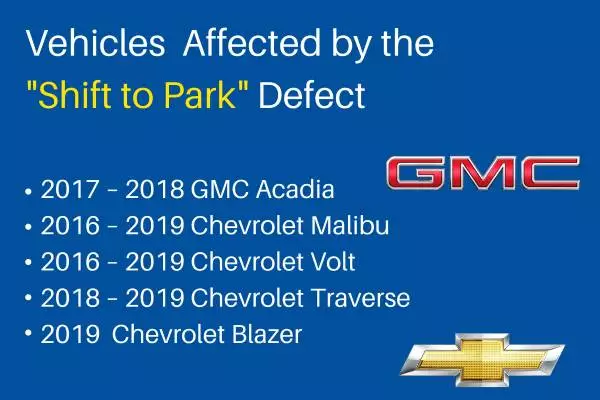
Although the Shift to Park issue does not present in all General Motors vehicles, it has been in an issue in the following models:
- 2017 – 2018 GMC Acadia
- 2016 – 2019 Chevrolet Malibu
- 2016 – 2019 Chevrolet Volt
- 2018 – 2019 Chevrolet Traverse
- 2019 Chevrolet Blazer
The Shift to Park defect affects 2017-2018 GMC Acadia SUVS. Numerous Acadia drivers have filed public complaints with the National Highway Traffic Safety Administration (NHTSA) regarding this issue. In June 2018, one Acadia driver informed NHTSA of the following:
“When the vehicle is in park and you try to turn it off with the start/stop button an on dash error code of ‘Shift to Park’ appears even though the vehicle is clearly in park. You are not able to turn the vehicle off. I took the vehicle in for service on 6/4/18 and was told that GM is aware of the issue, however, their engineers have not found a solution. This currently is forcing me to restart the engine, put my car in reverse, shift back in drive, try re-parking and turning it off again, repeating the process until it eventually turns off. I do not know if my car is truly in gear or not. I’m afraid that it might cause a dangerous situation.”
Can you File a Lawsuit?
There are currently several class-action lawsuits pertaining to the Shift to Park problems in GM vehicles. Pursuing an individual claim, however, may be the best way for you to receive compensation for your defective vehicle.
Filing an individual lemon law claim may be more beneficial to your situation than filing a class-action lawsuit. Often in large class-action suits, you are left splitting an award amongst potentially thousands of other individuals included in the suit.
Shift to Park issues are covered under the California Lemon Law. Lemons are vehicles with defects that affect their use, value, or safety. If it is determined that your vehicle is a lemon, you could qualify for a replacement vehicle, refund, or cash compensation for the loss in value of your vehicle plus the payment of your attorneys fees and costs.
A refund for your lemon would include your down payment, monthly payments, taxes, registration, and any incidental expenses associated with your lemon such as rental car or towing fees.
What are my Options?
If you are experiencing trouble with your GMC or Chevrolet vehicle, call our team of Lemon Law Experts to see if you qualify for a California lemon law claim. To determine if you are eligible, contact us so we can assess the details of your particular case and determine whether and how much compensation you may qualify for.
If you reside in California and are having problems with your GMC Acadia or any other GM vehicle, you should contact the Lemon Law Experts. As the state’s premier lemon law firm, we have helped thousands of consumers across the state of California recover millions in compensation for their defective vehicles in claims against large manufacturers like GM.
Our team of Experts can assist you in obtaining the compensation and the justice that you deserve. Give us a call or fill out an online case evaluation to find out what you could receive in recovery. Do not wait! Contact us today!