
Written By: Jessica Anvar Stotz
Legally Reviewed By: Jessica Anvar Stotz

Tesla is recalling around 239,000 vehicles across the United States due to a problem that could cause rearview cameras to stop working.

This announcement follows a recent investigation launched by the National Highway Traffic Safety Administration (NHTSA) into 2.6 million Tesla vehicles for incidents involving crashes related to the remote driving feature.

The automaker explained that the issue stems from a reverse current that may occur during startup, potentially leading to a short circuit in the vehicle’s computer board.

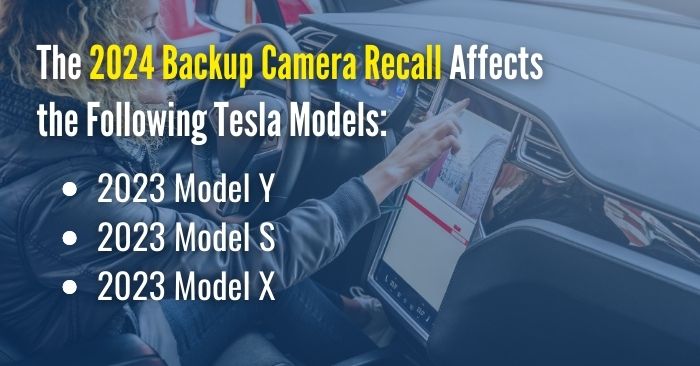
This could result in the rearview camera becoming non-functional. The recall applies to Tesla Model Y, Model S, and Model X vehicles from the 2024 and 2025 model years. The manufacturer estimates that 100% of recalled vehicles may have this defect.

The NHTSA has highlighted that this issue could potentially increase the risk of a collision. This recall comes merely months after Tesla, Inc. announced a massive recall of over 2 million vehicles due to an autopilot issue.

Having Vehicle Problems?

Submit the form below to see if your vehicle qualifies for a lemon law claim.

This field is for validation purposes and should be left unchanged.
(Required)
Agree(Required)

Tesla Backup Camera Recall Overview 2024

Previously in January 2024, Tesla, Inc. issued a recall of nearly 200,000 vehicles in the United States. The recall has been necessitated due to a potential malfunction of the backup camera, which may not operate as expected when the vehicle is placed in reverse.

According to documents released by the NHTSA in January 2024, the root cause of the issue appears to be software instability, which may intermittently prevent the backup camera from displaying images while the vehicles are in reverse.

Affected Tesla vehicles are distinctively equipped with the advanced “Full Self-Driving” computer 4.0 and operate on software versions ranging from 2023.44.30 to 2023.44.30.6 or 2023.44.100. The vehicle manufacturer estimates that 100% of the listed vehicles have this defect.

Warranty Claims Involving the Tesla Backup Camera Not Working

Although the NHTSA report does not link the defect to any accidents or injuries, there have been at least 887 warranty claims, and 68 field reports associated with the recall.

Tesla first identified the issue on November 21, 2024, after noticing an increase in car computer replacements due to failures in the primary or secondary power components caused by short circuits.

From November 26 to December 20, 2024, Tesla investigated the problem and traced it back to software versions released before 2024.44.25.3 or 2024.45.25.6.

The company determined that these earlier software versions, combined with colder temperatures, could cause a higher reverse current, leading to shorting in power components during startup.

The investigation concluded on December 27, 2024, leading Tesla to initiate a voluntary safety recall for 2023–2025 Tesla Model X and Model Y vehicles, along with 2024–2025 Tesla Model 3 and Model S vehicles.

The issue first came to light through customer complaints in late December 2023, when several drivers reported malfunctioning backup cameras.

After a thorough review, Tesla decided to initiate a recall on January 12, 2024. By January 22, the company had received 81 warranty claims related to the malfunction.

Despite Tesla’s “Full Self-Driving” system, the vehicles are not fully autonomous. This system is intended to assist drivers, not replace them, meaning human drivers must remain alert and ready to take control of the vehicle.

In early January 2024, the NHTSA launched an investigation into Tesla’s “Smart Summon” feature after 16 accidents involving the full-self-driving system, which failed to detect obstacles and caused collisions. These incidents resulted in property damage and posed injury risks.

This follows a previous investigation from October 2024, triggered by four pedestrian accidents, one fatal, involving Tesla vehicles with Full Self-Driving in low-visibility conditions, such as fog, sun glare, and dust.

Additionally, a wrongful death lawsuit was filed against Tesla last year, alleging the company misrepresented the safety of its Autopilot system.

The suit claimed that despite Tesla advertising Autopilot as a fully autonomous feature, its flaws led to a fatal collision with a fire truck, causing the death of a 33-year-old man.

tesla backup camera recall

Tesla Back Up Camera Fix

The recall affects certain 2024-2025 Model 3 and Model S sedans, as well as 2023-2025 Model X and Model Y SUVs. Starting on or around December 18, 2024, Tesla began rolling out a free over-the-air software update to modify the vehicle’s power-up sequence, aiming to prevent short circuit failures.

The automaker is still working to identify any vehicles that may have experienced circuit board failures or stresses that could lead to such issues. Owner notification letters are scheduled to be sent out on March 7, 2025.

Tesla owners can check the software versions installed on their vehicles by accessing the infotainment system, which displays the current version.

The OTA update is designed to rectify the glitch causing the backup camera malfunction. This update is delivered directly to the vehicles, eliminating the need for owners to visit a service center.

Once the update is available, owners will receive a notification on their vehicle’s infotainment screen. They can then choose to install the update immediately or schedule it for a later time.

Your Tesla vehicle must be connected to a Wi-Fi network to receive this OTA update. If owners have not yet received the update notification, they are advised to connect their vehicle to Wi-Fi and check for updates manually.

Tesla’s number for 2025 recall is SB-25-00-001. Customers may contact Tesla customer service at 1-877-798-3752 or the company’s contact for this recall, Sarah Shiver, via email at [email protected].

Owners with any additional questions can also contact the National Highway Traffic Safety Administration Vehicle Safety Hotline at 1-888-327-4236 (TTY 1-800-424-9153) or go to www.nhtsa.gov using NHTSA Campaign Number 25V-002.

If the OTA update does not resolve the issue, or if you need assistance with the update process, please contact Tesla customer service at 877-79-TESLA (877-798-3752). You can also fill out the contact form on the Tesla website or reach out to Tesla on social media sites like Twitter or Facebook.

For more specific inquiries or support, please visit the Tesla Support page. If you need a Service Center visit, you can schedule a service visit through the Tesla app.

Is your Tesla Model S, X or Y Backup Camera not Working?

If you’re a Tesla driver  dealing with issues related to the recent backup camera recall or other concerns, the Lemon Law Experts are here to help. Our firm is committed to ensuring you receive the justice and compensation you deserve.

We understand that these cases can be challenging, and we’re dedicated to making the process as seamless as possible for every client.

Our team will work diligently to communicate with the manufacturer on your behalf to achieve a resolution that meets your needs. If necessary, we’re prepared to take legal action to secure the best possible outcome.

At the Lemon Law Experts, our primary focus is ensuring you drive away with a safe, fully functional vehicle. Whether that means securing a full lemon law refund or cash compensation, we begin by thoroughly evaluating your case to determine the best course of action.

If your case meets the requirements for a lemon law claim, we’ll take all the necessary steps to help you reach a favorable resolution.

We strive to make the lemon law process as easy and stress-free as possible while working toward the best possible outcome. To find out if you qualify, call us at 877-891-2074 or complete a case evaluation form on our website today.

Citations

1.

“Tesla Autopilot Wrongful Death Lawsuit Filed After Fatal Crash With Self-Driving Software.” AboutLawsuits, 2023, www.aboutlawsuits.com/tesla-autopilot-wrongful-death-lawsuit-fatal-crash-self-driving-software/.

2.

“NHTSA Investigates Tesla ‘Summon’ Crashes.” WDSU, 2023, www.wdsu.com/article/nhtsa-investigates-tesla-summon-crashes/

3.

“Tesla Smart Summon Under Investigation by NHTSA.” AboutLawsuits, 2023, www.aboutlawsuits.com/tesla-smart-summon-under-investigation-nhtsa/.

4.

“Tesla Recalls 239K Vehicles Over Rearview Camera Display Short in Car Computer: NHTSA.” AutomotiveDive, 2025, www.automotivedive.com/news/tesla-recalls-239k-vehicles-rearview-camera-display-short-car-computer-nhtsa/737217/.

5.

“US Traffic Safety Regulator Opens Probe Into About 2.6 Million Tesla Vehicles.” Reuters, 7 Jan. 2025, www.reuters.com/business/autos-transportation/us-traffic-safety-regulator-opens-probe-into-about-26-mln-tesla-vehicles-2025-01-07/.

6.

“Tesla Recalls About 239,000 Vehicles Over Rear-View Camera Issue.” Reuters, 10 Jan. 2025, www.reuters.com/business/autos-transportation/tesla-recalls-about-239000-vehicles-over-rear-view-camera-issue-2025-01-10/.

7.

National Highway Traffic Safety Administration. “Recall Report 25V002.” NHTSA, 2025, nhtsa.gov/odi/rcl/2025/RCAK-25V002-9065.pdf.

8.

National Highway Traffic Safety Administration. “Recall Report 25V002.” NHTSA, 2025, nhtsa.gov/odi/rcl/2025/RCLRPT-25V002-6930.PDF.

9.

National Highway Traffic Safety Administration. “Recall Report 24V035.” NHTSA, 2024, nhtsa.gov/odi/rcl/2024/RCLRPT-24V035-6803.PDF.

10.

“Tesla Recalls More Than 2 Million Cars in U.S. to Fix Autopilot Flaw.” Forbes, 13 Dec. 2023, www.forbes.com/sites/siladityaray/2023/12/13/tesla-recalls-more-than-2-million-cars-in-us-to-fix-autopilot-flaw/?sh=1f2261bb3467.

11.

Associated Press. “Tesla Recall: Backup Camera Display Goes Dark, Requires Software Update.” AP News, apnews.com/article/tesla-recall-backup-camera-screen-dark-software-update-e8cc7acb4395a99789c2fee680bfeab3.

See More
The Lemon Law Experts
Privacy Overview

This website uses cookies so that we can provide you with the best user experience possible. Cookie information is stored in your browser and performs functions such as recognising you when you return to our website and helping our team to understand which sections of the website you find most interesting and useful.